
English
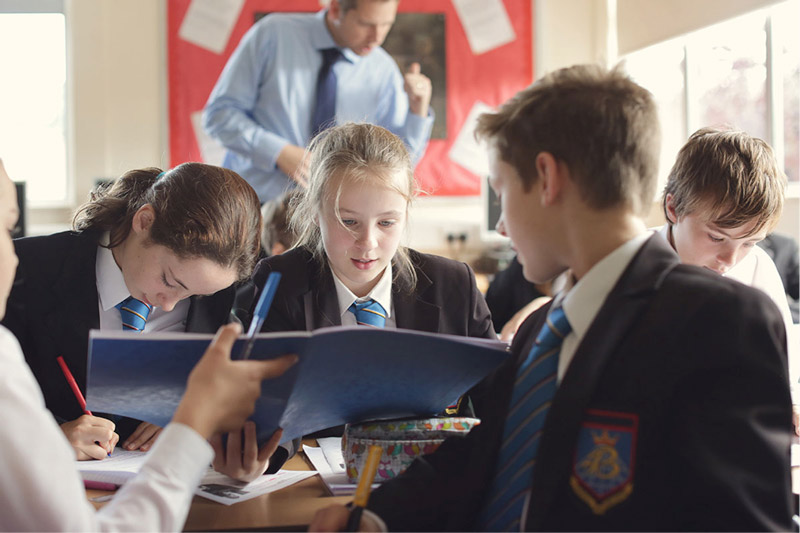 The department consists of eight full time English specialists all of whom teach across the full 11-18 age and ability range. The department is housed on two floors in the main school block along with the library which staff are able to make full use of in lessons. All of the English rooms are equipped with data projectors, interactive whiteboards and networked computers on which students are able to research and work in lessons.
Curriculum intent
It is key to the success of the English department that every member has a say and a stake in the development of the curriculum and the provision that we offer. The curriculum has been designed and written over many years and the courses that we offer are comprehensively in-house resourced. Pupils are encouraged to develop the skills of reading, writing, speaking and listening. They will do this through the reading and writing of poems, plays and stories, as well as through role-play and dramatic activities. They will work on their own, in pairs and in groups, in the library, the computer room and in the classroom.
All resources are stored digitally which means that we can adapt them efficiently and share them easily with students. It is a fundamental part of everyday department practice that, whilst we have developed extremely high-quality resources, these are not rigidly delivered in a one size fits all approach, but as individual practitioners we use our knowledge as experienced professionals to adapt those resources to the needs of our own individual learners. It is our practice that we all teach the same unit at the same time so that (a) there is a coherent experience for students, and (b) informal teacher discussions enable the sharing of ideas and approaches. All English staff teach across the full age and ability range and whilst we have setted groups, there are no teachers who tend towards teaching one type of group rather than another.
Students in Key Stage 3 experience a wide range of literature texts, both modern and 19th century, from Treasure Island in Y7, to Animal Farm in Y8 and Blood Brothers in Y9. They are also introduced to Shakespeare through their study of The Tempest in Y7 and more in-depth work on Shakespeare with Romeo and Juliet in Y9. Students are encouraged to think and write creatively writing ghost stories in Y7, horror stories in Y8 and dystopian fiction in Y9. We study war poetry in Y8 and begin Power & Conflict poetry at the very end of Y9. Students encounter non-fiction texts in the World Today unit in Y7 and Greek Mythology in Y8. Writing in a specific form and for a specific audience such as letters, leaflets etc is also integrated within the literature tasks that we deliver. We are great believers in the power of speaking: the end of Y7 culminates in a public speaking competition where tutor groups compete against eachother. It is our intention that students enter KS4 having laid a very solid foundation in KS3 for all of the skills that they will be assessed on at GCSE.
Students work in exercise books and these act as a record of the work that they have done. All units begin with an individual knowledge organiser for that unit (blue sheet) and most end with a green assessment sheet. As a department we are moving to more whole class ‘green sheet’ assessment sheets as both a visible, practical and effective means of evidencing progress and developing skills.
Lessons are structured in a variety of ways but our endeavour is always for students to discuss, reflect, challenge and ultimately to become increasingly independent readers and writers and to enjoy the pursuit of English for its own sake. A qualification in English demonstrates that one is a skilled reader and an adept writer with the ability to evaluate an opinion, the skills to argue a viewpoint and the imagination to empathise with another’s situation.
Curriculum links to the whole school Aims
The English department at Balcarras offers a broad, balanced and relevant curriculum which covers each of the 3 main literature genres (prose, drama and poetry) with an increasing depth of challenge at each stage. We also teach non-fiction texts and writing to encourage students to see how writing may be shaped to achieve particular outcomes and ends.
We encourage success in all its forms and mark positively with a focus in each formal assessment on ‘what went well’ (www) accompanied by and ‘even better if’(ebi) or ‘next steps’ statement as part of the high expectations that we have for every pupil. We ensure equal access in that all students follow the same English curriculum adapted according to need. We believe in the expertise of our teachers who know their students and are equipped with the skills to deliver our curriculum in an appropriate and relevant manner.
Students spiritual, moral, social and cultural development is fostered through discussions of issues raised in the texts that we study. Examples of this would include the effects of class in society in Blood Brothers, the taking of personal responsibility in An Inspector Calls and the uses and abuses of power in Animal Farm. We develop students ‘cultural capital’ by reading and discussing Greek myths in Y8 and Y10 and consider the relevance of the moral questions posed to our lives today. We also explore toxic masculinity in Romeo and Juliet and the notions of kingship and moral leadership in Macbeth. Cultural capital is also reinforced in the contextual areas that we cover in WW1 and Power & Conflict poetry, the Russian Revolution in Animal Farm in which we also address concepts of democracy and individual liberties, and the treatment of the poor in Victorian England in A Christmas Carol with a focus on Dickens’ message (through Scrooge’s transformation) of kindness, community and generosity of spirit.
We run theatre trips where we can to see performances of the texts that we study such as Blood Brothers and An Inspector Calls. We also organise a Macbeth theatre workshop for Y11 each year with an RSC educational outreach practitioner and have also arranged for a theatre company to come in to school to do a performance of Macbeth. A few Y8 students are currently taking part in a creative writing workshop across the Cheltenham schools’ partnership and we have also taken Y13 students to hear the AC Bradley Memorial lecture. We have very strong links with the Shakespeare Institute in Stratford who run an A level study day for us each year in the autumn term and a Y7 day in the summer term. The end of each academic year culminates in a Y7 inter-tutor group public speaking competition performed in front of the whole year group.
Progression of skills
|
|
Reading |
Writing |
S&L |
||||
|---|---|---|---|---|---|---|---|
|
YEAR |
NOVEL
|
POETRY
|
SHAKESPEARE
|
MODERN DRAMA
|
CREATIVE FICTION
|
CREATIVE NON-FICTION
|
SPOKEN LANGUAGE
|
|
|
Treasure Island
|
Embedded into units.
(Mainly Shakespeare and Ghost Stories) |
Intro: The Tempest |
|
Ghost Stories |
The World Today |
Public Speaking: Story Telling
Ghost Stories Assessment |
|
8
|
Animal Farm |
WW1 Poetry |
|
|
Subverting Fairy-tale and Horror Genre |
Transactional Writing through Greek Mythology |
Crime Fiction Assessment |
|
|
Novel |
Conflict Poems Introduction to GCSE poetry |
Romeo and Juliet |
Blood Brothers |
Dystopian Fiction |
Blood Brothers (Transactional Writing integrated into tasks) |
Blood Brothers Assessment |
|
GCSE
|
A Christmas Carol |
Power and Conflict Poetry |
Macbeth |
An Inspector Calls |
Language Paper 1 |
Language Paper 2
|
Spoken Language Component |
|
A Level
|
Frankenstein
The Handmaid’s Tale |
Poems of the Decade (Post-2000’s)
Victorian Poetry |
Othello |
A Streetcar Named Desire |
Academic essay writing
Critical readings
|
||





 7
7
 9
9

Key Stage 3 Curriculum map
|
|
Autumn Term 1 |
Autumn Term 2 |
Spring Term 1 |
Spring Term 2 |
Summer Term 1 |
Summer Term 2 |
|---|---|---|---|---|---|---|
|
Year 7 |
|
|||||
|
Year 8 |
||||||
|
Year 9 |
GCSE Curriculum map
|
|
Autumn Term 1 |
Autumn Term 2 |
Spring Term 1 |
Spring Term 2 |
Summer Term 1 |
Summer Term 2 |
|---|---|---|---|---|---|---|
|
Year 10 English Literature |
||||||
|
Year 10 English Language |
English Language Papers 1 & 2 Theme of Social Justice | English Language Papers 1 & 2 Theme of Social Justice | English Language Papers 1 & 2 Theme of Social Justice | English Language Papers 1 & 2 Theme of Social Justice | ||
|
Year 11 English Literature |
-Literature Paper 1 Mock |
Revision of Literature Texts |
Revision of Literature Texts |
GCSE Literature Exams |
||
|
Year 11 English Language |
Revision of Language Questions |
GCSE Language Exams |
A level Curriculum map
|
|
Autumn Term 1 |
Autumn Term 2 |
Spring Term 1 |
Spring Term 2 |
Summer Term 1 |
Summer Term 2 |
|---|---|---|---|---|---|---|
|
Year 12 Teacher 1 |
- Finish Novels |
- Revision & Exams |
||||
|
Year 12 Teacher 2 |
|
|
Finish Novels |
- Revision & Exams |
||
|
Year 13 Teacher 1 |
-Trial Exams - Coursework essay: first draft |
- Revision of Y12 Texts - Coursework essay: final draft
|
Revision |
A Level Exams |
||
|
Year 13 Teacher 2 |
- Trial Exams - Coursework essay: first draft |
- Revision of Y12 Texts - Coursework essay: final draft
|
Revision |
A Level Exams |
For more information on Careers please click here
Key Stage 3
In Key Stage 3, students follow six half termly units per year which, across years 7 to 9, comprise fiction, non-fiction, media, creative writing, drama, a Shakespeare unit, a performance poetry unit and speaking and listening tasks. In Year 7, students read the novel Treasure Island by Robert Louis Stevenson and they also cover Shakespeare's The Tempest; in Year 8, we do Animal Farm by George Orwell; and in Year 9 we do Romeo and Juliet and Of Mice and Men. All schemes of work have been devised in-house by the department and are regularly reviewed and developed. Each unit of work is followed by an assessment where progress is measured against grade specific criteria. In Year 7, pupils are taught in mixed ability tutor groups and in Years 8 & 9 divided into sets following a broad upper/middle/lower pattern. KS3 students receive 6 English lessons a fortnight.
GCSE
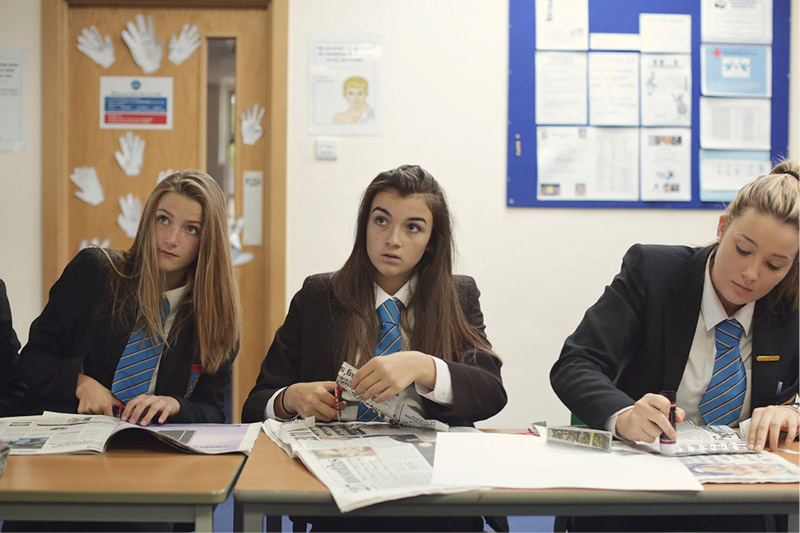 We follow the AQA syllabus and all students do English and English Literature. The texts that we study are An Inspector Calls, A Christmas Carol, Macbeth and the Power and Conflict anthology poems. We try to teach the language units thematically and to integrate descriptive, narrative and the unseen fiction and non-fiction tasks alongside our study of the literature texts. Students are reset at the start of Year 10 according to a broader whole school banding policy with maths and science, but which again follows the basic upper/middle/lower pattern.
A Level
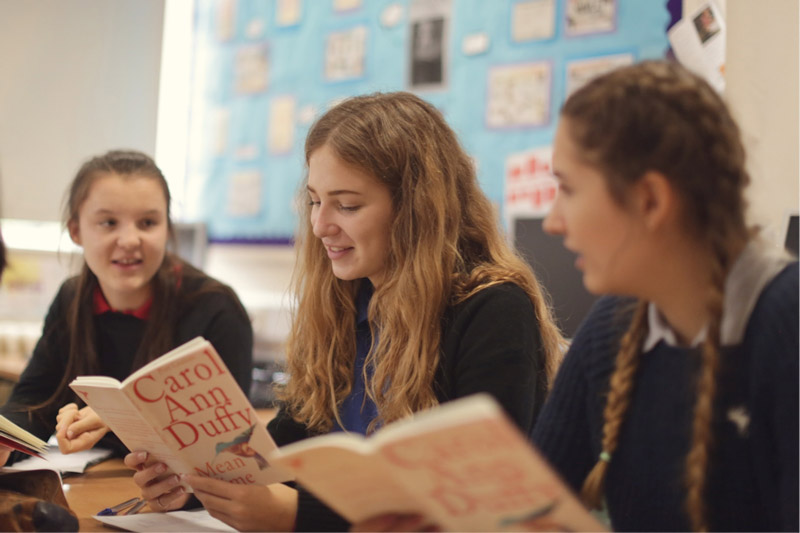 The department offers the Edexcel English Literature syllabus at A level and take up is extremely healthy. Students study the novels Frankenstein and The Handmaid's Tale for their prose paper; Victorian poetry and Poems of the Decade for their poetry paper; and Othello and A Streetcar Named Desire for their Drama paper. Students also have to complete a coursework essay (NEA) of 2,500 to 3,000 words in length comparing two texts of their choice. Students are prepared for this in Y12 and submit their essay in Y13.
Trips
Extra-curricular activities are extremely important to us. We try to take students to live performances of their set texts. We get involved in the Cheltenham Literature Festival by attending author events from Y7 through to A level. We also run in-house events such as an annual Y7 public speaking competition.